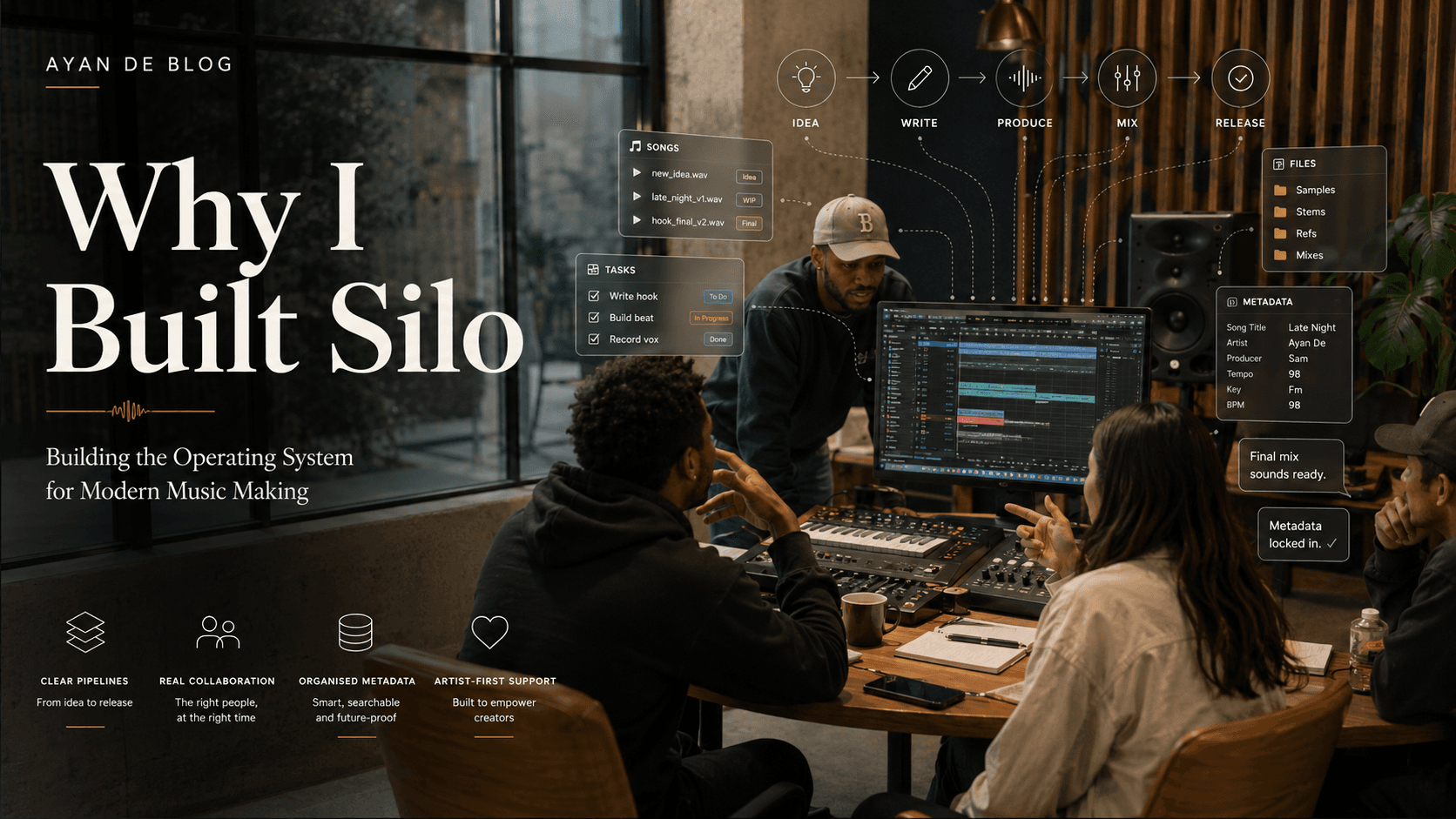
The problem was fragmentation
A modern musician may write in a notes app, exchange references on messaging platforms, store versions in cloud folders, track tasks in a project tool, search for collaborators on social media and maintain metadata in spreadsheets. Each tool may work, but the project does not exist coherently in any of them.
This fragmentation creates invisible labour. People spend time asking which file is current, what was approved, who is waiting, whether the publishing information is complete and what needs to happen next. The creative process becomes harder to see precisely when more people become involved.
A song has a lifecycle
I built Silo around the idea that a song is not merely a file. It is a changing body of work with stages, jobs, people, decisions, assets and rights information. Writing, producing and recording are connected, but they are not the same activity. Each creates different tasks and different evidence of progress.
Silo gives that lifecycle a visible structure. The purpose is not to force every artist into one rigid method. It is to make the next useful action clear while preserving the history of the project.
Guidance without taking over
Many creative tools are either empty workspaces or automated systems that try to make the art. I wanted Silo to occupy a different position: a guided creative engine that helps people organise, remember and collaborate without replacing authorship.
That means the product should understand context. A lyric task, a mix note and a missing contributor credit are all different. They need different interfaces, permissions and reminders. The system should behave more like a producer or project lead who knows the state of the work than a generic to-do list.
The career around the song
Songs eventually meet the world. They need artwork, metadata, distribution, publishing administration, promotion, collaboration, fan relationships and opportunities. These activities are often treated as a separate business layer, but for independent creators they are part of the same reality.
Silo is intended to connect the making of the work with the career infrastructure around it. The long-term idea is an ecosystem where creators can move from a private project pipeline into collaboration, professional services, releases and audience relationships without rebuilding the information every time.
Why I personally needed it
I have spent years moving between composing, producing, mixing, studio operations and product development. I repeatedly saw excellent work lose momentum because the process around it was unclear. Talent was not the problem. Memory, coordination and access were.
Silo is my attempt to encode the useful parts of professional practice—the sequence of questions, checks and handovers—into a system that can serve people who do not yet have a full team.
A company built around continuity
The name Silo is deliberately paradoxical. Creative industries are full of silos: departments, folders, platforms and private knowledge. The company exists to connect them. Its products are being designed around continuity between tools, people and stages of work.
I did not build Silo because musicians need another place to upload files. I built it because creative work deserves a durable memory, and creators deserve infrastructure that understands both the song and the life around it.