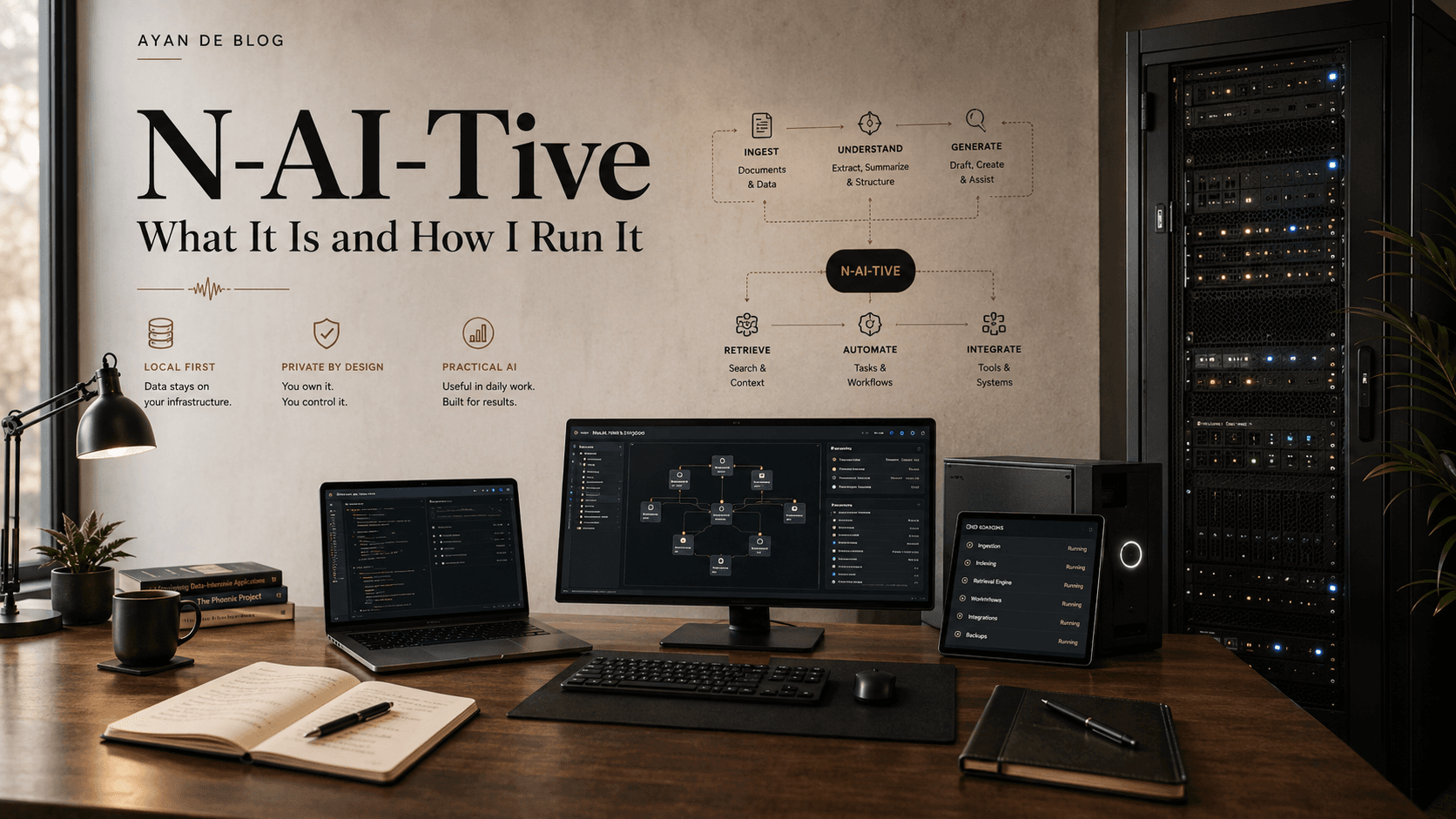
AI that belongs inside the organisation
Most people experience AI as a website: type a request, upload a document and receive an answer from infrastructure operated elsewhere. That model is convenient, but it is not ideal for every company. Some organisations work with sensitive contracts, unreleased products, private financial information, customer data or intellectual property that should remain under tighter control.
N-AI-Tive is built around local or privately controlled AI systems. Depending on the client, the system may run on hardware in the office, on a dedicated private server or in a carefully isolated deployment. The objective is not isolation for its own sake. It is operational control.
What the system actually does
A useful local AI must do more than host a chatbot. It needs access to approved company knowledge, clear permissions and tools that map to real work. It may search internal documents, prepare summaries, draft routine material, compare versions, analyse spreadsheets, support coding, generate internal visuals or help leadership retrieve decisions.
The model is only one component. Document ingestion, retrieval, identity, audit logs, backups, update policy and user interface determine whether the system becomes dependable.
How I operate it
I treat each deployment as an information-system project rather than a hardware sale. We begin by mapping the organisation's tasks and data. We identify what must remain private, what can use external services, who should see which sources and which actions require approval.
The system is then assembled from appropriate models and tools. Not every task needs the largest model. Smaller specialised models can be faster and cheaper for retrieval, transcription, classification or image work. A routing layer can send each request to the most suitable local capability while preserving a consistent interface.
Maintenance is part of the product
Local AI does not become maintenance-free because it is on-premises. Models, drivers, indexes and connectors need updates. Storage needs monitoring. Backups and recovery must be tested. New documents need to enter the knowledge base through a controlled process, and deleted or restricted information must actually disappear from retrieval.
I prefer scheduled maintenance, versioned changes and clear ownership. A business should know which model is running, when it was updated, what data it can access and how to disable a connector.
Where local AI is strongest
Local deployment is especially valuable when the knowledge is private, repeated and organisation-specific. Leadership teams can interrogate company documents. Operations teams can standardise recurring work. Creative companies can search archives without exposing unreleased material. Regulated or confidentiality-sensitive workflows can keep a clearer boundary around data.
It is not automatically the cheapest option. Hardware, electricity and maintenance are real costs. For occasional general questions, a hosted service may be more efficient. N-AI-Tive is designed for organisations where control, customisation and repeated internal use justify the infrastructure.
The principle behind the name
N-AI-Tive refers to AI becoming native to the workplace: present in the organisation's own environment, shaped around its language and connected to its actual processes. The aim is not to create a machine that knows everything. It is to create a system that knows what it is allowed to know, performs defined work reliably and remains accountable to the people operating it.