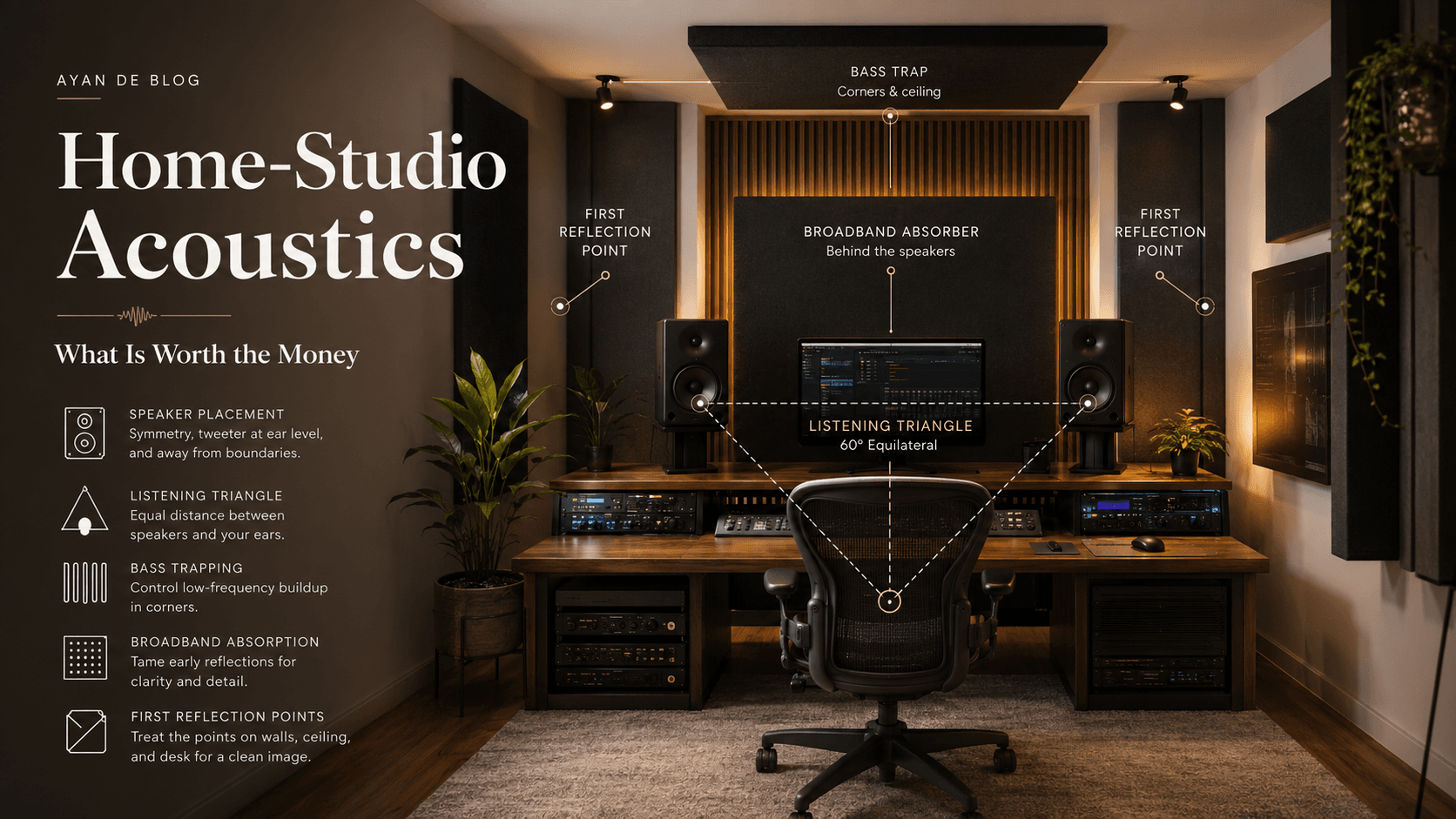
The room is part of the monitoring chain
A monitor does not deliver sound directly to your ears in isolation. It excites the room, and the room adds reflections, resonances and cancellations. This is why buying more expensive speakers can produce surprisingly little improvement when the listening geometry remains poor.
The most valuable first step is not treatment. It is understanding the room: dimensions, construction, listening position, speaker distance, boundaries and the places where low-frequency energy builds or disappears.
Great value: placement and symmetry
Placement costs nothing and can transform the result. Begin with left-right symmetry around the listening position. Keep the speakers and ears in a sensible triangle, match tweeter height and avoid placing one speaker near a side wall while the other opens into a doorway. Small adjustments in distance from the front wall can change bass response dramatically.
The listening position should not be chosen because the desk fits there. It should be tested. Moving the seat forward or backward can reduce a severe null more effectively than buying another device.
Great value: broadband absorption
For most small rooms, properly built broadband absorbers provide excellent value. Thick mineral-wool or fibreglass panels with an air gap can control early reflections and absorb into the lower midrange. First-reflection points on the side walls and ceiling are common priorities, followed by treatment behind or around the monitors depending on the room.
Thickness matters. Very thin foam may reduce flutter and high-frequency brightness while leaving the lower spectrum untouched. This can make the room sound dull without making it accurate.
Great value: bass trapping and measurement
Low frequencies are usually the hardest problem in a home studio. Effective bass trapping requires depth, surface area and sensible placement, often in corners or across boundaries. It is not a small decorative triangle. In constrained rooms, large broadband traps are often more practical than narrow tuned devices.
A measurement microphone and reputable analysis software are among the best-value purchases available. Measurement does not replace listening, but it prevents guesswork. It reveals decay, major peaks, nulls and the effect of each change. Measure one intervention at a time.
Often a waste: cosmetic foam and random diffusion
Cheap foam packs are frequently sold as complete acoustic solutions. They can reduce high-frequency reflections, but they rarely solve the low-frequency problems that make mixing unreliable. Covering every wall in thin foam may create an unbalanced, uncomfortable room.
Diffusion is also misunderstood. A proper diffuser needs adequate depth, distance and predictable geometry. In a very small room, placing shallow decorative blocks behind the head may create strong close reflections rather than spaciousness. Diffusion becomes valuable when the room has enough distance for the scattered energy to develop.
Correction software is not construction
Room-correction software can improve tonal consistency at the listening position, but it cannot remove a long decay, stop a reflection from smearing imaging or fill a deep cancellation with unlimited amplifier power. It works best after physical placement and treatment have reduced the largest problems.
Spend in this order: geometry, placement, measurement, broadband treatment, bass control, calibration and only then decorative finishing. A home studio does not need to look like a laboratory. It does need each purchase to address a measured problem.