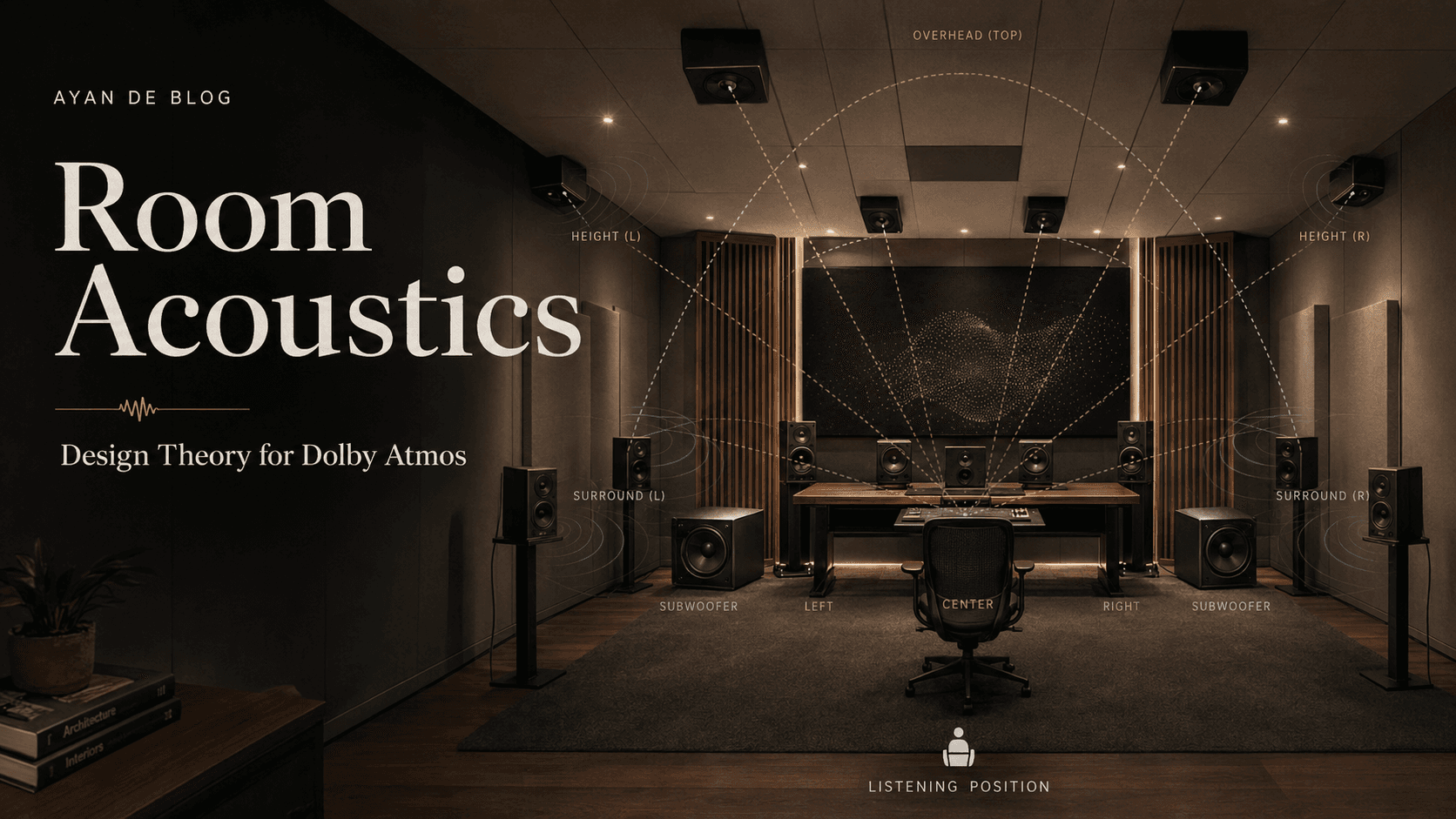
From a listening point to a listening volume
Stereo design concentrates heavily on a frontal image between two loudspeakers. Dolby Atmos adds side, rear and overhead channels, which means the room must support localisation across a volume rather than only across a line. Reflections that seem harmless in stereo can pull images upward, widen them unpredictably or make transitions between speakers uneven.
The objective is not to make the room completely dead. It is to create controlled, comparable paths from every loudspeaker to the listening area.
Geometry comes before treatment
Speaker angles, distances, elevation and sightlines should be designed before absorbers and diffusers are finalised. The room dimensions and listening position determine whether the required layout can be achieved without extreme compromises. Professional Dolby guidance provides target layouts and design tools; these should be treated as the starting framework rather than replaced by intuition.
The front stage, surrounds and heights must form a coherent system. Height speakers should not feel like a separate effect layer. Their coverage and timbre need to connect smoothly with the ear-level array.
Control early reflections consistently
Early reflections influence localisation and tonal balance. In an immersive room, the challenge is consistency: one speaker should not arrive through a heavily absorbed path while another has a strong nearby reflection. Reflection-control decisions therefore need to be mapped for the complete array.
Broadband treatment is generally safer than excessive high-frequency-only absorption. The room should retain enough life to feel natural while preventing strong discrete reflections from competing with direct sound.
Low-frequency design is system design
The low end is shared by the room, not owned by one speaker. Modal behaviour, subwoofer placement, crossover design, bass management, structural isolation and decay all interact. Multiple subwoofers may improve spatial consistency, but only when placement, delay, level and equalisation are integrated.
A flat response at one microphone position is not the entire goal. The system should remain predictable across the working area and should not achieve a graph by creating excessive ringing or headroom loss.
Calibration protects translation
Level, delay, polarity, frequency response and speaker capability need to be verified. Atmos work depends on relative accuracy: a small level or timing error can change apparent position. Calibration also checks whether the system has sufficient headroom at the intended monitoring level.
Room correction can assist, but it should not conceal physical mistakes. A loudspeaker aimed incorrectly or placed against an untreated reflective boundary is better fixed in the room than compensated with increasingly complex filters.
Design for long sessions
An immersive room is a workplace. Sightlines, console height, screen position, ventilation noise, equipment heat and ergonomics matter. Overhead speakers must not create visual or physical discomfort. The acoustic design must also preserve communication and allow clients to experience the work without occupying a completely different tonal environment.
A successful Atmos room feels calm. Objects move without obvious jumps, the centre remains stable, the heights are convincing rather than detached, and bass does not change dramatically with small head movements. That calmness is the result of disciplined geometry, treatment and calibration—not simply the number of loudspeakers.