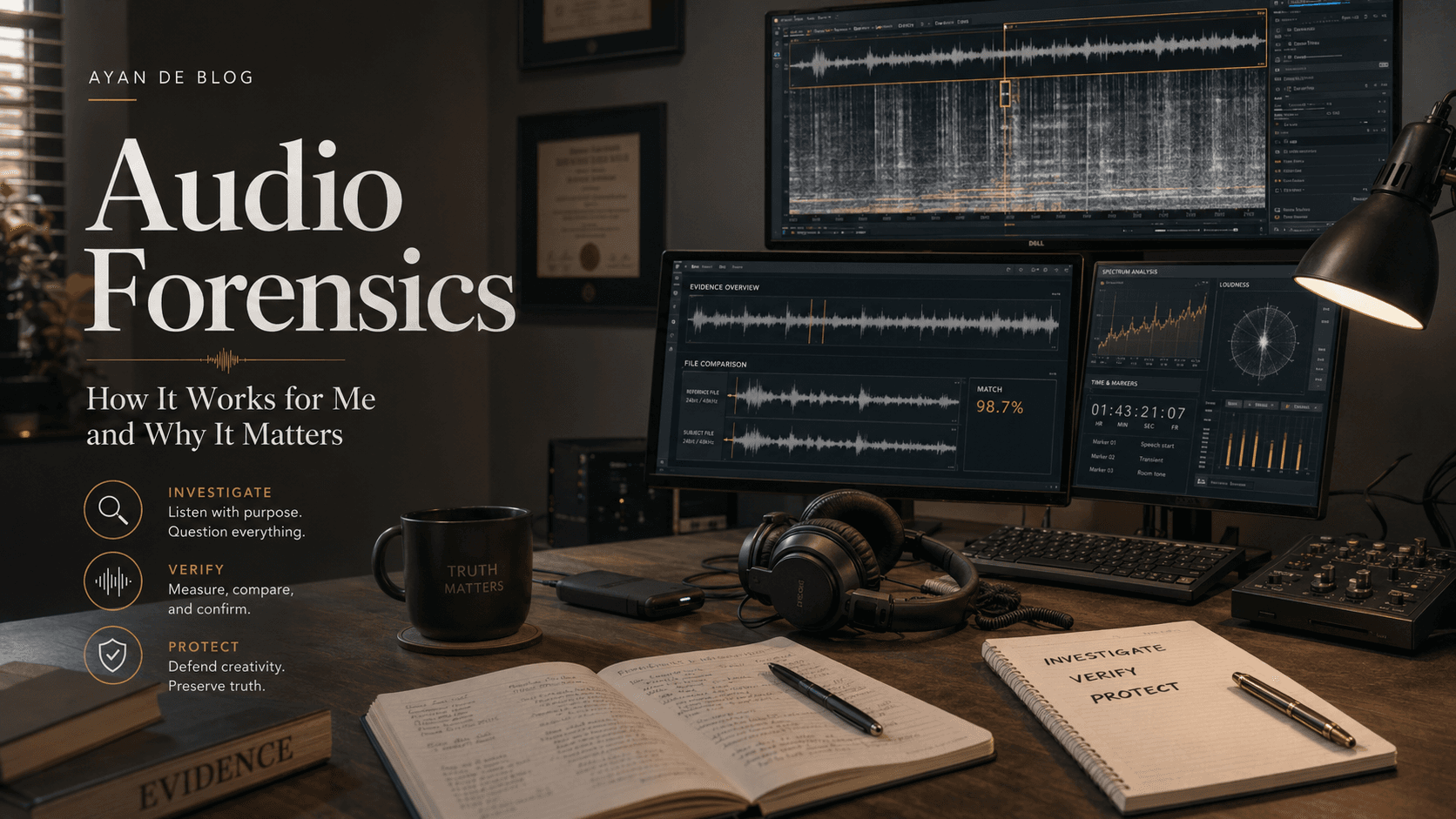
Most people think of a recording as a finished object.
A song is mixed, mastered, exported and released. At that point, it appears to have a fixed identity.
In reality, a recording begins changing almost as soon as it leaves the studio.
It may be converted into different formats for streaming. It may be compressed for messaging applications or social media. It may be shortened into a promotional clip, embedded inside a film, slowed down, pitch-shifted, processed, sampled or recorded from a television or loudspeaker.
The original file may have been a high-resolution WAV, but the version that eventually needs to be investigated may be a distorted recording captured on a mobile phone.
This is where audio forensics becomes important.
Audio forensics is the process of examining sound as evidence. It involves looking beyond the title, filename or metadata and studying the recording itself.
The objective is to understand whether two pieces of audio are connected, what type of connection may exist, and what changes may have occurred between the original and the questioned material.
Why Listening Is Not Always Enough
Human hearing is exceptionally good at recognising music.
A listener may immediately recognise a melody, vocal, drum pattern or production element. But recognition and verification are not the same thing.
A person may be able to say:
“That sounds like the same recording.”
A forensic workflow must ask more specific questions.
Is it the same master?
Is it an alternate version?
Is it a short excerpt from a longer recording?
Has the audio been compressed or re-encoded?
Has it been pitched up or slowed down?
Was it recorded from a speaker?
Is only one element of the original production present?
Could the similarity come from the underlying composition rather than the same sound recording?
These distinctions matter because different relationships between recordings can have very different creative, commercial and legal implications.
Audio forensics helps move the discussion away from instinct alone and towards structured evidence.
How I Use Audio Forensics
My work normally begins with a known reference.
This is often an approved master, a mix, a stem, an unreleased recording or another file whose origin is already understood.
That reference becomes the point against which questioned audio can later be examined.
The first step is to establish exactly what the reference is.
This may sound obvious, but productions frequently contain multiple versions of the same song: rough mixes, vocal-up versions, clean edits, instrumental versions, radio edits, alternate masters and platform-specific exports.
A reliable investigation depends on knowing which version is being examined.
From there, I analyse the questioned material and assess how it relates to the reference.
The process may involve several forms of comparison.
Exact File Comparison
The simplest case is when two files are digitally identical.
This can sometimes be established using basic file-level information. However, exact file matching is only useful when the audio has not been re-exported, converted or modified.
Even a simple format change can produce a completely different file while preserving substantially the same sound.
This means file comparison is useful, but it is only the first layer.
Audio Signal Comparison
The next level is examining the decoded audio signal itself.
Two files may have different names, metadata, formats and sizes while still containing effectively the same recording.
This often happens when a master is converted from WAV to another format or passed through a distribution platform.
Signal-level examination can help determine whether the underlying audio remains connected despite these changes.
Partial and Excerpt Matching
A questioned recording is not always a complete copy.
It may contain only a few seconds of the original. It may be hidden inside a longer video, advertisement, television programme or social-media post.
This requires identifying meaningful sections of audio rather than expecting the entire file to match from beginning to end.
A useful forensic system must therefore be able to work with fragments and not only complete recordings.
Transformation Analysis
Audio may also be deliberately or unintentionally altered.
Common transformations include:
- Pitch changes.
- Tempo changes.
- Compression.
- Equalisation.
- Limiting.
- Added noise.
- Format conversion.
- Editing and rearrangement.
- Playback through a loudspeaker.
- Recording through a microphone.
- Mixing underneath speech or sound effects.
These changes can make a straightforward comparison much more difficult.
In such cases, I look for evidence that remains consistent even when the recording has been transformed.
The aim is not to pretend that altered audio is identical to the original. It is to determine whether a meaningful relationship still exists.
The Role of Watermarking
Audio watermarking is one part of this broader field.
A watermark places identifying information into the audio itself rather than relying only on the filename or metadata.
The idea is valuable because metadata is fragile. It can be stripped during export, transcoding or upload. A watermark is intended to remain connected to the sound.
However, watermarking should not be misunderstood as an indestructible lock.
No responsible system should claim that a watermark can survive every possible transformation or deliberate attempt at removal.
For me, watermarking is most useful when it forms one part of a larger evidence system.
It can provide an additional signal, but it should be supported by registration records, audio comparison, version tracking and clear documentation.
A watermark alone may tell you that something was detected.
A complete forensic workflow should help explain what was detected, where it was detected, what it relates to and how that conclusion was reached.
Why I Built Silo Trace
I built Silo Trace because most audio-protection tools solve only one part of the problem.
Some tools focus on registration.
Some focus on watermarking.
Some focus on file matching.
Others focus on legal documentation after a dispute has already begun.
What was missing was a connected workflow that could begin when a recording is still under the creator’s control and continue through to a later investigation.
Silo Trace is designed around that complete lifecycle.
A recording can be registered as a known reference before it is released, distributed or shared.
If questioned audio appears later, it can be examined against that registered reference.
The system can then help describe the type of relationship that exists between the recordings and produce a structured technical record of the findings.
The important difference is that the result is not treated as a simple yes-or-no answer.
An exact duplicate is different from a compressed copy.
A compressed copy is different from a short excerpt.
A short excerpt is different from a transformed derivative.
The reporting should reflect those differences.
Registration Before the Problem Exists
One of the most important principles in my workflow is proactive registration.
Many audio disputes begin too late.
A suspicious clip is discovered, and only then does everyone begin searching through drives, emails and old project folders to determine which version of the recording was sent and who may have received it.
By that point, the history of the file may already be unclear.
Registering the approved recording early creates a reliable technical reference before that uncertainty appears.
This is particularly useful for:
- Unreleased music.
- Sync submissions.
- Advertising pitches.
- Film and television deliveries.
- Label submissions.
- Publisher deliveries.
- Collaborator exports.
- Review copies.
- Alternate masters.
- Confidential works in progress.
The objective is not to treat every collaborator or recipient as a threat.
It is to ensure that the identity and history of the recording remain clear as it moves through a complex production or commercial process.
Reporting Is Part of the Forensic Work
Finding a technical relationship is only part of the job.
The finding must also be communicated clearly.
Audio-forensics reports may be reviewed by people with very different levels of technical knowledge. These may include musicians, label teams, publishers, lawyers, broadcasters, producers and clients.
A report therefore needs to explain:
- Which files were examined.
- Which recording was used as the reference.
- What type of relationship was identified.
- Which portions of the audio were relevant.
- What changes may have occurred.
- What evidence supports the finding.
- What limitations remain.
The report should distinguish observation from interpretation.
For example, proving that two files are digitally identical is different from identifying a transformed excerpt inside another production.
Both may be valuable findings, but they should not be described in the same way.
Good forensic reporting makes this distinction visible.
Audio Forensics Does Not Decide Ownership
It is also important to understand what audio forensics cannot determine on its own.
A technical match does not automatically prove ownership.
It does not establish whether the use was licensed.
It does not decide whether someone had permission.
It does not determine who owns the composition, the recording or a particular performance.
Those questions depend on contracts, copyright law, licensing terms and the specific context of the use.
Audio forensics supports those discussions by answering the technical questions more clearly.
It can help establish whether recordings are related, how they may be related and what appears to have happened to the sound.
The resulting evidence can then be reviewed alongside contracts, delivery records and legal advice.
Why It Matters Now
Audio has become easier to create, copy and transform than at any previous point.
A finished recording can be distributed globally within minutes. It can also be altered using tools that require very little technical knowledge.
AI-generated music, voice cloning, automated stem separation and increasingly sophisticated audio-processing systems have made the boundaries between original, copied and transformed material more complex.
This does not mean that every similarity is theft or misuse.
It means that reliable verification is becoming more important.
Creators and rights holders need systems that can preserve the history of their work without depending entirely on filenames, platform metadata or memory.
They also need tools that can operate in the real world, where audio is rarely discovered in its original form.
The Larger Purpose
I do not see audio forensics as a way to police every use of sound.
I see it as a way to create clarity.
It gives artists and rights holders a better record of what they created.
It gives production teams a clearer history of what was delivered.
It gives investigators a more reliable reference.
It gives legal and licensing teams structured technical information.
Most importantly, it helps prevent a recording’s identity from disappearing simply because the file has been renamed, converted or altered.
The goal is not to make audio impossible to copy.
The goal is to make its history easier to understand.
That is why audio forensics matters, and that is the problem I am working to solve with Silo Trace.