Start with the listening promise
Before choosing codecs, controls or cloud services, a consumer app needs to define the listening promise it is making. Is the player optimised for instant access, discovery, high-fidelity listening, spoken word, short-form clips, unstable mobile networks or a mixture of these? The answer determines almost every technical decision that follows.
A player that promises audiophile quality but takes several seconds to begin will feel broken. A player that starts instantly but changes loudness unpredictably will feel careless. Product design begins by ranking these tensions rather than pretending they do not exist.
Metrics that describe the experience
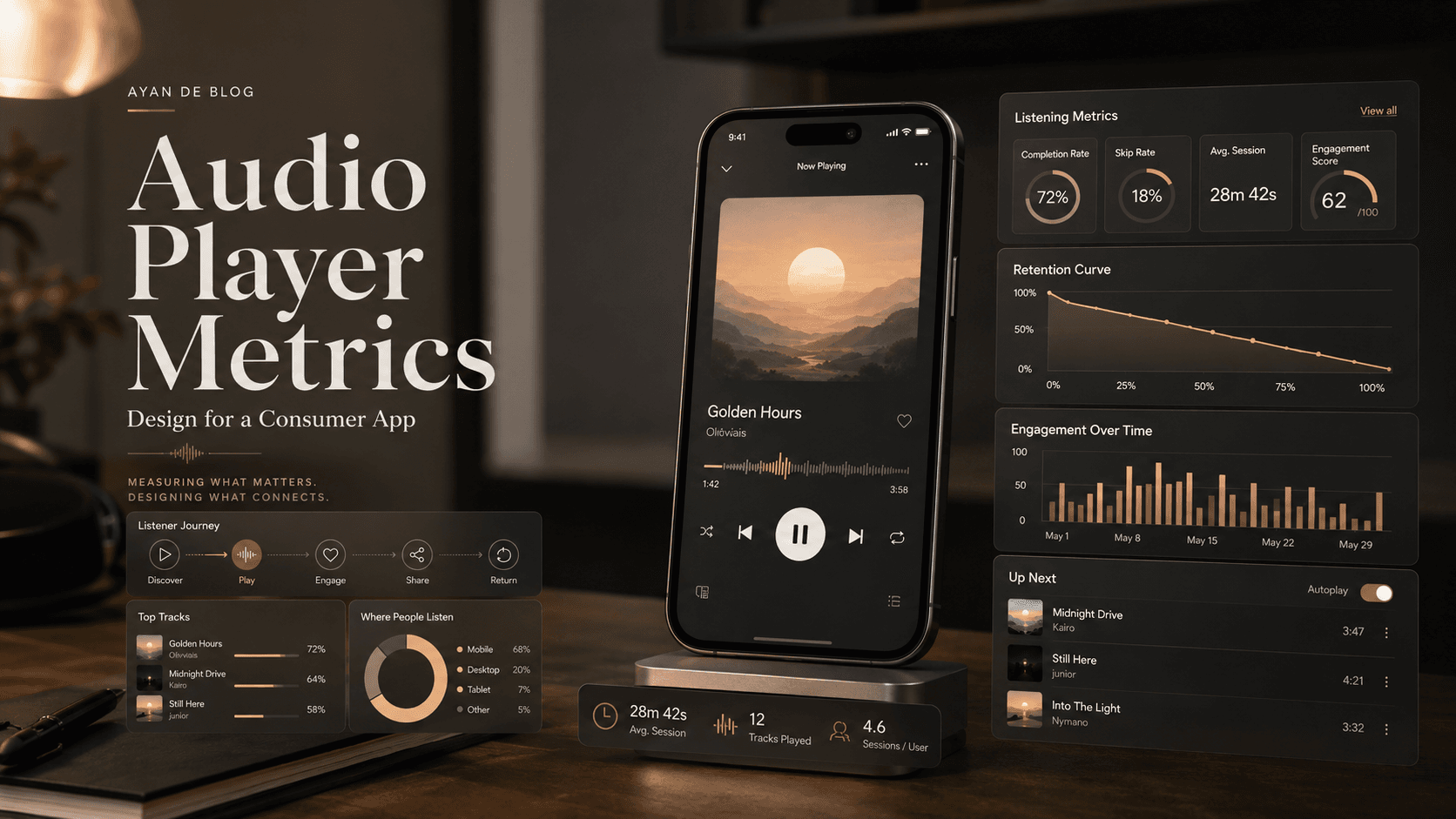
The most useful player metrics connect engineering behaviour to what a listener actually feels. Time to first audio measures how quickly playback begins. Rebuffer rate and rebuffer duration describe interruptions. Start failure rate shows how often a request never becomes sound. Playback error rate, seek latency, track-transition gap, battery impact and data consumption reveal other forms of friction.
Audio-specific metrics matter too: delivered codec, sample rate, bit depth, channel configuration, loudness adjustment, true-peak protection and whether the client fell back from a preferred quality. These should be logged with device, operating system, network class and app version so that failures can be diagnosed rather than averaged away.
Loudness, level and artistic intent
Consumers expect songs to sit together comfortably, but they also expect the music to retain its dynamics. A well-designed player can apply loudness normalisation using established programme-loudness and true-peak measurements without permanently changing the source master. The important distinction is between playback gain and destructive remastering.
The interface should also communicate modes honestly. A default listening mode may prioritise consistent level and reliable fallback. An artist or fidelity mode may preserve the supplied master more directly, request lossless assets and reduce intervention. These modes must be technically defined; they should not become vague marketing labels.
The control surface
Good controls reduce doubt. Play state, buffering, quality, queue position, device route and download state should be understandable at a glance. Scrubbing must feel attached to the audio rather than to a delayed server response. A user should know whether a track is playing from a download, a cache or the network, particularly when data usage matters.
Accessibility should be part of the original design. Controls need clear labels, sensible focus order, adequate touch targets, screen-reader support and alternatives to colour-only status indicators. Spoken-word and long-form users may need playback speed, chapter navigation, sleep timers and durable position history. Music users may value gapless playback, crossfade control, credits and precise queue behaviour.
Resilience is a product feature
Mobile audio lives in imperfect conditions: elevators, trains, handovers between Wi-Fi and cellular networks, low-power mode and interruptions from calls or navigation. The player should buffer intelligently, retry without creating duplicate sessions and resume from a predictable point. It should distinguish a rights failure from a network failure and explain the difference in human language.
Offline behaviour is equally important. Downloads need integrity checks, storage management and clear expiry rules. Protected content should remain secure without making legitimate listeners repeatedly authenticate.
Design the observability with the player
A player cannot be improved if the team only sees crashes. Playback events should form a coherent timeline: request, entitlement, manifest, selected rendition, first byte, decode, first audio, quality changes, stalls, seeks, completion and abandonment. Privacy-safe analytics can reveal where listeners leave and whether the problem is content, network, device or interface.
The best consumer player is not the one with the longest feature list. It is the one that makes a complex delivery system feel immediate, stable and respectful of the recording.