Why another format?
Most digital audio formats are designed for interchange. That is normally a strength: a WAV, FLAC or ALAC file can move between compatible tools and devices. But there are cases where the release is meant to behave more like a physical edition—authorised, contained and connected to a specific player or object.
Siloenc began with that product question. Could high-resolution audio be delivered with the ceremony and control of a collectible medium while retaining the convenience of digital playback?
What 'SACD-quality' means here
The phrase 'SACD-quality' is used to communicate the intended listening tier rather than claim that the format is literally the SACD specification. The design target is a premium, high-resolution listening experience with careful source preparation, controlled decoding and a signal path capable of preserving the supplied master.
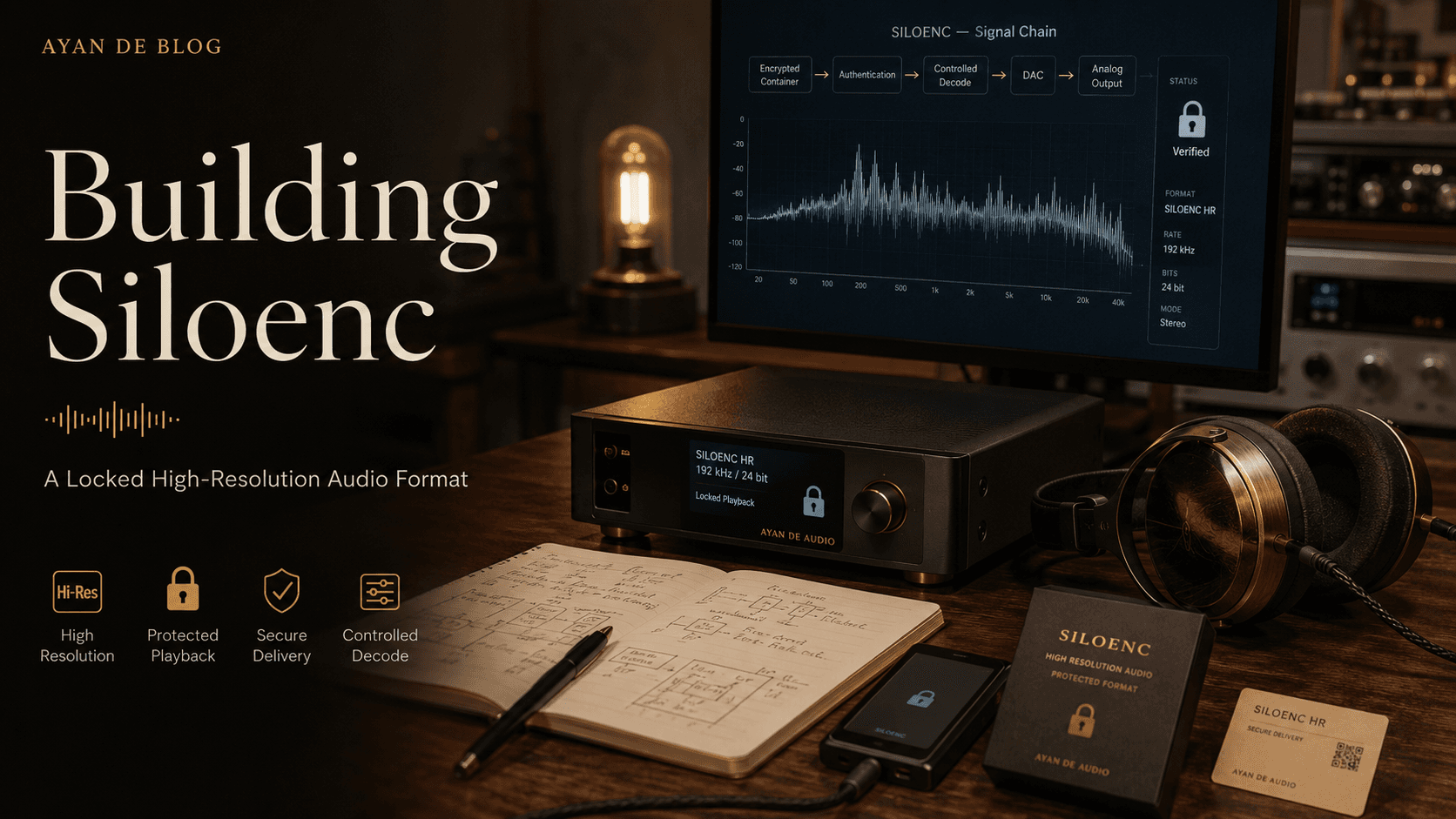
Quality is not created by a file extension. It depends on the source, conversion, reconstruction filters, gain handling, device output and monitoring chain. Siloenc therefore has to be treated as part of a complete playback system rather than as a standalone container.
Locked does not mean immortal
No consumer protection system should be described as impossible to defeat. If audio can be heard, it can ultimately be re-recorded. The purpose of a locked format is to raise the level of control, reduce casual extraction, bind access to authorised products and preserve provenance.
The public design principle is layered protection: the asset, entitlement, player and release identity work together. The implementation details—key management, container structure, cryptographic choices and anti-tamper mechanisms—are deliberately not published.
A codec is also a product contract
The format must define what happens when a device is offline, a licence expires, a player is updated or a customer moves to new hardware. It must handle corruption, partial downloads and interrupted transfers. It also needs a migration strategy so that legitimate owners are not stranded by future software changes.
These questions are as important as compression efficiency. A collectible digital release fails if its protection makes ownership fragile.
Preserving the master
A premium format needs disciplined ingestion. Source masters should be validated, versioned and checked for clipping, channel errors, metadata problems and unintended conversions. The encoded asset should be verified after creation, and the authorised player should reproduce it predictably.
The objective is not to make every recording louder or brighter. It is to preserve the artistic master and provide transparent information about the delivered resolution and playback path.
The larger Silo idea
Siloenc connects to a broader belief: digital music can have stronger identity. A release can include provenance, credits, visual material, documentation and a defined listening environment. The file becomes one component of an edition rather than an anonymous object separated from its history.
The interesting part of Siloenc is therefore not a secret algorithm. It is the attempt to combine high-resolution audio, controlled access and collectible design without pretending that convenience and security have no trade-offs. Those trade-offs are the real engineering work.