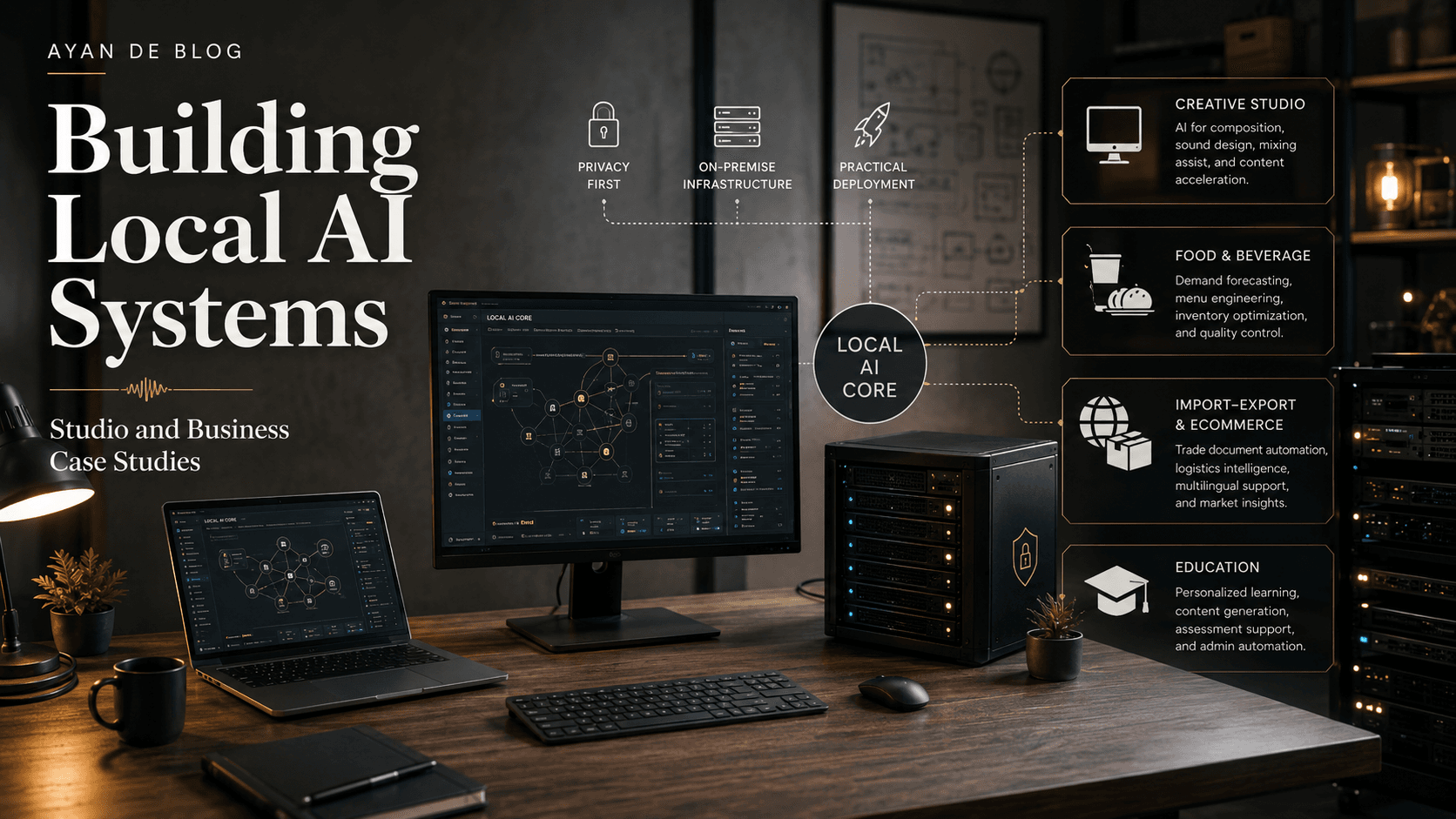
Four systems, four jobs
I have approached local AI in four very different contexts: Stitch Audio, my own cross-project research environment, and leadership systems for companies in food and beverage, import-export and e-commerce, and education. These examples are deliberately described at a public level. The private data, credentials, retrieval indexes, prompts and internal procedures remain protected.
The common lesson is that 'install an AI' is not a useful brief. Each system needs a job description.
Stitch Audio: protecting creative context
For Stitch Audio, the value lies in understanding technical documents, room information, equipment notes, session procedures, delivery standards and accumulated production knowledge. A studio AI should help retrieve and connect that information without ingesting unreleased client audio into uncontrolled services.
The system can support preparation, documentation and troubleshooting. It should not make unreviewed creative decisions or expose one client's material to another. Project separation and permissions are fundamental.
My own system: connecting disciplines
My personal system needs to move across audio engineering, product development, research, writing and company strategy. The challenge is not a shortage of information but too many disconnected contexts. A useful assistant must recognise which project a document belongs to and avoid blending speculative notes with approved decisions.
I organise sources by project, status and sensitivity. Retrieval is more valuable when it can distinguish a current specification from an old brainstorm.
Food and beverage leadership
For an F&B founder, local AI can help make operating knowledge searchable: recipes and specifications, supplier information, training documents, outlet procedures, campaign notes and leadership reporting. Permissions are especially important because staff, managers and founders should not receive the same financial or personnel information.
The system should answer practical questions quickly and show the source, rather than inventing operational policy.
Import-export and e-commerce
In an import-export and e-commerce business, the information changes frequently. Product records, shipment documents, vendor communication, classification notes, returns and marketplace requirements all carry dates and jurisdictions. The AI therefore needs strong source attribution and freshness controls.
It can organise and compare documents, but legal, customs and tax decisions still require qualified review. The system should surface uncertainty instead of converting an old document into confident advice.
Education
An education business has another challenge: different audiences. Leadership, teachers, administrators, students and parents require different views of the same organisation. A local system can help prepare material, search policies, organise curriculum resources and answer internal questions while respecting student privacy.
Guardrails are not an afterthought. The system must know when to retrieve, when to draft and when a human educator must decide.
The architecture that repeats
Across these cases, the repeatable structure is straightforward: approved data enters a controlled store; documents are parsed and indexed; identity determines access; a retrieval layer supplies relevant context; one or more models perform defined tasks; and logs allow review. Backups, update procedures and deletion are part of the architecture.
What changes is the business logic. Local AI succeeds when it is designed around the organisation's decisions, not around a model benchmark.